

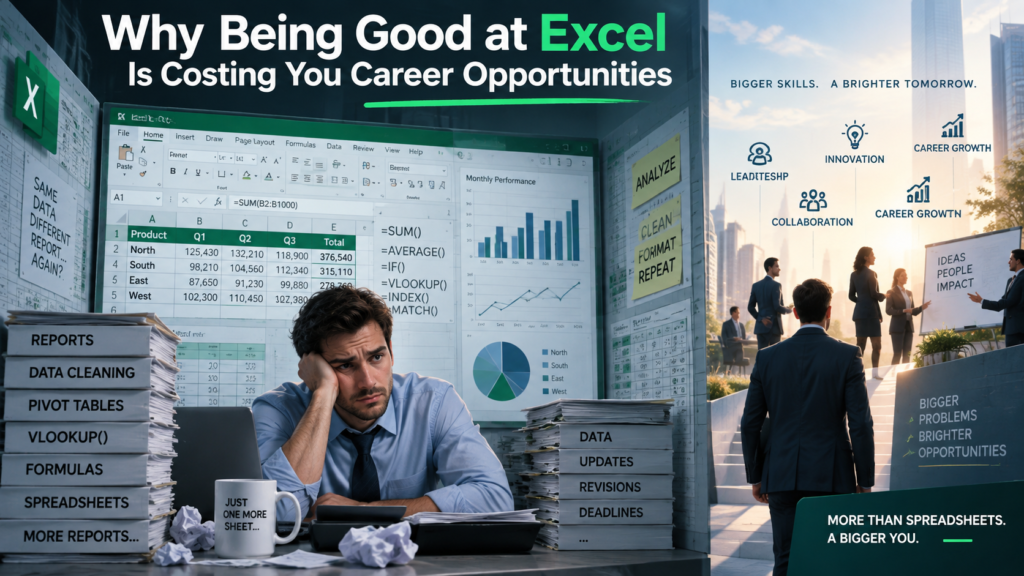
Being the person everyone goes to for a formula fix feels like a compliment. It isn’t always one. Staying good at Excel career opportunities wide open sounds contradictory, but that’s exactly the trap: the more indispensable you become for spreadsheet fixes, the easier it is for managers to keep you exactly where you are. If you’ve been “the Excel person” for years without a title change or a pay rise to match, the skill that got you noticed may now be the thing quietly capping your career.
This article breaks down why being good at Excel stops being an asset past a certain point, what it’s actually costing you, and how to reposition yourself for the roles and pay you’re being passed over for.
The “Good at Excel” Career Trap, Explained
Early in a career, Excel proficiency is a genuine differentiator. It gets you noticed, gets you pulled into projects, and builds a reputation as someone reliable with data. The trap appears later: once you’re known purely as “good at Excel,” colleagues and managers stop associating you with strategy, leadership, or decision-making. You become the person who executes the analysis, not the person who’s consulted on what the analysis means. That distinction is exactly where promotions, pay rises, and senior title changes happen, or don’t.
How Being Good at Excel Quietly Costs You Career Opportunities
You Get Pulled Into Tasks, Not Decisions
Being the reliable spreadsheet fixer means you’re the person asked to clean the data, not the person asked what the data should drive. Over time, this keeps you visible for execution work and invisible for strategic conversations, which is exactly where promotion decisions get made.
Your Skill Set Reads as “Support,” Not “Leadership”
Recruiters and hiring managers quietly categorise candidates. “Advanced Excel skills” alone tends to read as an operational support skill set. Roles like Business Analyst, Data Analyst, or Operations Manager expect Excel as a baseline, plus evidence of tools and thinking that show broader ownership: Power BI, SQL, process improvement, or project leadership.
You Plateau at the Same Salary Band
Excel-only skill sets tend to cluster in the same salary band for years, because the market prices “Excel proficiency” as a baseline administrative or analyst skill, not a specialised or strategic one. Adjacent skills, dashboarding, data modelling, automation, command noticeably higher pay because they signal a broader value contribution.
You Miss Roles That Were Never Advertised as “Excel Roles”
Many of the best next-step roles, Data Analyst, Reporting Analyst, Business Intelligence Analyst, Operations Lead, never mention Excel in the title at all, even though Excel is part of the day-to-day. If your resume and LinkedIn only say “Excel,” you’re filtered out of searches for these adjacent, better-paid roles before a human ever reads your application.
Excel-Only Skill Set vs Career-Advancing Skill Set
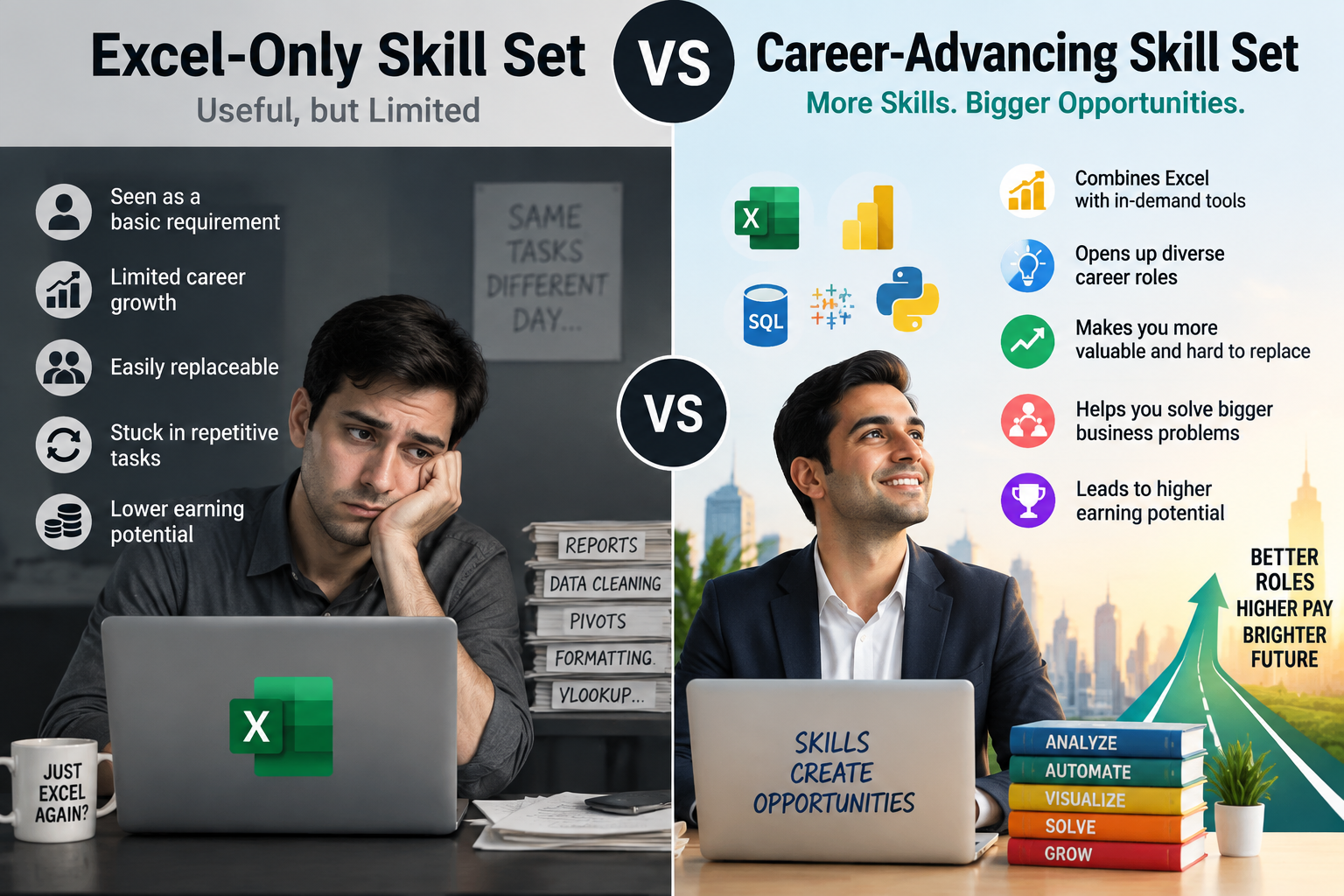
| “Good at Excel” Skill Set | Career-Advancing Skill Set |
| Formulas, VLOOKUP/XLOOKUP, Pivot Tables | Power BI dashboards and data storytelling for stakeholders |
| Manually cleaning and reformatting data | Power Query and automation to remove repetitive manual work |
| Building one-off reports on request | Owning recurring reporting processes end-to-end |
| Being the go-to fixer for spreadsheet errors | Being consulted on what the numbers mean for the business |
| Excel-only resume keyword | Excel plus Power BI, SQL, or process improvement keywords |
| Reactive, task-based visibility | Proactive, decision-influencing visibility with leadership |
How to Break Past the “Good at Excel” Ceiling
- Reframe your value out loud. Stop describing yourself as “good at Excel” in meetings, reviews, and your resume. Describe the business outcomes your analysis has driven instead.
- Add one visible tool beyond Excel. Power BI is the most natural next step, since it builds directly on Excel data skills while signalling analyst-level, not support-level, capability.
- Automate the repetitive work you’re known for. Use Power Query and Power Automate to remove manual tasks from your week, freeing time for higher-visibility work and demonstrating process-improvement thinking.
- Volunteer for the decision, not just the data. Ask to present findings yourself instead of handing off a finished spreadsheet. This is the single highest-leverage way to shift how you’re perceived.
- Update how you’re positioned externally. Rewrite your resume and LinkedIn headline around outcomes and adjacent tools, not “Advanced Excel user,” so you stop being filtered out of better-paid, adjacent roles.
Certifications That Signal You’re Beyond “Just Excel”
- Advanced Excel and Power Query certification proves you can automate, not just manually manage, data.
- Microsoft Power BI (PL-300) the most natural next step from Excel into recognised analyst-level tooling.
- Data analytics fundamentals training builds the broader analytical thinking that sits behind promotion decisions.
If Excel is still the core of your day-to-day, start by closing the gaps our guide covers in Advanced Excel Skills Employers Want in Australia in 2026, then explore automation with Power Query for Beginners: Clean and Transform Data Without Coding. For the deeper structural view on this exact problem, see Why Your Excel Skills Are Holding Back Your Career (And How to Fix It).
Take the next step into dashboarding and analyst-level reporting through powerbicourse.au, or explore the full data analyst pathway at dataanalyticscourses.au. Both are delivered through Logitrain, Australia’s IT training provider.
Where This Shift Is Happening Across Australia
Employers across every major Australian market are increasingly filtering for the broader, career-advancing skill set over Excel alone:
- Sydney — finance and corporate roles favouring analysts who can move from Excel into Power BI reporting.
- Melbourne — government and enterprise employers rewarding automation and process-improvement thinking.
- Brisbane — growing demand for analysts who can own reporting end-to-end, not just format it.
- Perth — resources sector roles pairing Excel with dashboarding and operational reporting.
- Adelaide — defence and government roles valuing structured, automated reporting processes.
- Canberra — federal roles increasingly expecting Power BI or equivalent alongside core Excel skills.
Frequently Asked Questions
Why isn’t being good at Excel enough for career growth anymore?
Because Excel proficiency is now a baseline expectation rather than a differentiator. Career growth comes from skills that signal decision-making and strategic value, like Power BI, automation, and business storytelling.
What career opportunities does being “only” good at Excel cost you?
It commonly costs promotions into analyst or leadership roles, access to higher salary bands, and visibility for adjacent roles like Data Analyst or Business Intelligence Analyst that rarely advertise “Excel” in the title.
What’s the best next skill to learn after Excel?
Power BI is the most natural next step, since it builds directly on existing Excel data skills while repositioning you as an analyst rather than a spreadsheet support resource.
How do I show I’m more than “the Excel person” at work?
Reframe how you talk about your work around business outcomes, volunteer to present findings rather than just prepare them, and add one visible tool or certification beyond Excel to your profile.
Can I fix this without changing jobs?
Yes, in most cases. Adding visible skills, changing how you’re positioned internally, and volunteering for higher-visibility work can shift how you’re perceived in your current role before you need to change employers.
Final Thoughts
Being good at Excel isn’t the problem, staying only good at Excel is. If your reputation, resume, and role are still built entirely around spreadsheet fixes, that’s the exact gap keeping you out of the next tier of roles and pay. Add one adjacent skill, change how you talk about your work, and stop letting “good at Excel” be the ceiling instead of the foundation it was always meant to be.