





The capability wealth gap is the difference between professionals who keep adding to what they can do and professionals who only keep adding to what they have to do. Two colleagues can start in the same role, work the same hours and be equally reliable. Five years later, one is trusted with bigger decisions, better projects and a stronger pay conversation. The other is busier than ever, still doing a more crowded version of the same job.
Most people assume the difference is talent or luck. It rarely is. More often it comes down to what each person does with the hours they already spend at work. One treats those hours as a place to complete tasks. The other treats them as a place to build capability. Over time that small difference compounds, much like savings and investments do.
This guide explains the capability wealth gap in plain language, shows where Microsoft Excel skills sit right in the middle of it, and gives you practical steps to increase your value rather than your workload, wherever you work in Australia. If you want to see the training options first, browse our Excel courses online in Australia.
What Is the Capability Wealth Gap?
Think of your career the way you think about personal finances. Your salary is income. Your capability is wealth. Income is what you are paid for the hours you work. Wealth is what keeps paying you after those hours are done: the skills, systems and judgement that make you faster, more accurate and harder to replace.
The capability wealth gap opens when two people earn similar income but build very different wealth. One person spends six hours every month rebuilding the same report by hand. The other spends a few extra hours once, builds a repeatable process and finishes the same report in half an hour from then on. Same job title, very different position a year later.
Capability wealth is usually made up of four things:
- Reusable tools: templates, models, macros and queries that save time every single cycle.
- Technical depth: skills in Microsoft Excel, Power Query and similar tools that the people around you don’t have.
- Trusted numbers: work that others rely on without double-checking it.
- Judgement: the ability to explain what the data means and what should happen next.
Why Workload Grows Faster Than Value
If building capability is so useful, why do so many capable people skip it? Because the way modern work is organised quietly rewards the opposite, which keeps the capability wealth gap open.
- Reliability gets punished with more work. The person who always delivers is the person who gets handed the next task.
- Urgent beats important. Deadlines are visible. Learning is not, so it slips to “next quarter” every quarter.
- Manual habits scale badly. A task that takes an hour when it happens once a month becomes a serious drain when five similar tasks arrive together.
- Nobody audits capability. Hours are tracked and outputs are counted. Skills gained are rarely measured, so they rarely get managed.
The result is a loop. You do the task manually, you are asked to do it again, and you do it manually again. The capability wealth gap widens quietly, and it usually takes a missed promotion or a burnout conversation before anyone notices.
Signs You Are Increasing Workload Instead of Capability
You don’t need a performance review to spot the pattern. Check how many of these sound familiar:
- You rebuild the same report by hand every week or month.
- You copy and paste data between files and tabs for much of the day.
- You say “it’s quicker if I just do it myself” because nobody else knows how the file works.
- You can’t name a new skill you’ve gained in the past twelve months.
- You are praised for effort and speed, but rarely for insight.
- Your calendar is full, yet your role looks the same as it did two years ago.
If you ticked three or more, you are probably on the wrong side of the capability wealth gap, and the issue isn’t your work ethic. It is how your hours are being invested. We explore the manual-work side of this problem in the copy-and-paste economy, and the related trap of being busy rather than valuable in the career difference between being busy and being effective.
How Excel Skills Close the Capability Wealth Gap
Excel is where most Australian professionals first meet the capability wealth gap. It is used across administration, finance, accounting, HR, operations, project management and small business, so a modest improvement in Excel skills tends to save time in several places at once. Even better, Excel skills compound. A formula you learn today, a PivotTable you build once and a macro you record in an afternoon keep working every week after that.
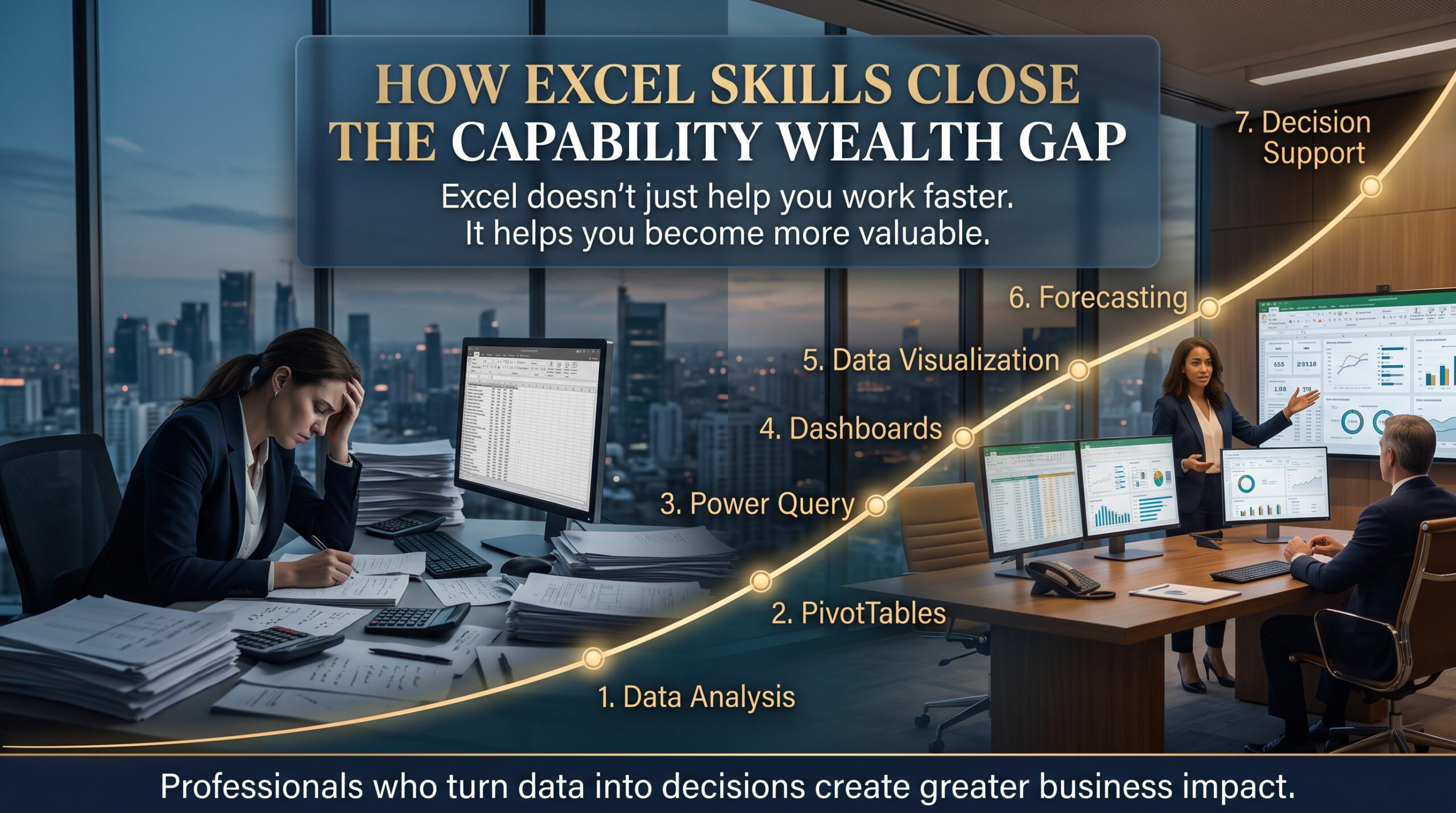
The table below shows how the same task looks when you are adding workload and when you are adding capability.
| Task | Workload Habit | Capability Habit |
| Monthly reporting | Rebuild the report by hand and re-paste fresh data | Refresh with Power Query and a reusable PivotTable template |
| Finding data | Search manually and copy values across | Use lookup formulas such as XLOOKUP or INDEX and MATCH |
| Repetitive formatting | Format each file one cell at a time | Record or write a macro that does it in one click |
| Sharing results | Email a large, hard-to-read workbook | Build a clean dashboard with charts and slicers |
| Checking accuracy | Eyeball the totals and hope | Use data validation, error checks and reconciliation formulas |
None of the capability habits require a computer science degree. They require structured learning, realistic practice and a little patience. That is exactly what our beginner, intermediate and advanced Excel courses are built for.
Which Skills Build Capability Wealth Fastest?
Not every skill narrows the capability wealth gap equally. The ones that build capability wealth fastest are the ones you reuse often and that other people depend on. Here is a practical way to map your next step to a course:
| Capability | What It Builds | Start Here |
| Formulas and formatting | A solid base for accurate everyday spreadsheets | Microsoft Excel Beginner |
| Functions, charts, data organisation | Faster analysis and clearer reporting | Microsoft Excel Intermediate |
| PivotTables, analysis, dashboards | Insight that decision-makers actually use | Microsoft Excel Advanced |
| Automation and VBA | Repeatable processes that save hours every cycle | Excel VBA and Macros Masterclass |
| Role-specific Excel | Skills tied directly to your job function | Excel for Accountants |
| Business Excel | Models and tracking for small teams and owners | Excel for Small Business |
| Presenting results | Communicating findings so people act on them | Microsoft PowerPoint |
| Credential | Formal proof of Microsoft Office skills | MOS Exam Preparation |
If you aren’t sure where to start, read about why data-savvy employees get promoted or how professionals become indispensable at work. Both pair well with the table above.
The Capability Wealth Gap in Action: Four Examples
These are composite examples based on common workplace patterns, not individual case studies.
- HR officer in Sydney: compiles headcount and leave data manually each month. After learning structured formulas and PivotTables, the report takes minutes and the time saved goes into workforce analysis. See Excel for HR Professionals.
- Accountant in Melbourne: spends days on reconciliations. With lookup formulas, data validation and error checks, reconciliations become a review task instead of a rebuild. See Excel for Accountants.
- Operations coordinator in Brisbane: tracks stock across several spreadsheets. A single linked model replaces them and flags shortages early. See Excel for Supply Chain and Inventory.
- Project manager in Perth: maintains status trackers by hand. A dashboard with automatic roll-ups gives leadership a live view without a weekly rebuild. See Excel for Project Managers.
In each case the person didn’t work harder. They invested once in capability and let it keep paying them back, which is how the capability wealth gap closes in practice.
A Practical Capability Audit You Can Do This Week
You can start closing the capability wealth gap without enrolling in anything. This simple audit takes about an hour:
- List your repeated tasks. Write down everything you do weekly or monthly that follows roughly the same steps.
- Time them. Estimate hours per month for each task. The numbers are usually higher than you expect.
- Pick the biggest time drain. Choose the one task where saving time would matter most.
- Build it once. Turn it into a template, a query or a macro. Test it against last month’s results.
- Document and share it. Write three lines explaining how it works. Capability that only lives in your head is still workload.
- Reinvest the saved time. Put at least half of it into learning your next skill or improving how you explain the results.
Repeat the audit every quarter. Over a year, those small deposits add up to real capability wealth and a narrower capability wealth gap.
Three Myths That Keep the Capability Wealth Gap Open
- “I don’t have time to learn.” The professionals with the least time are usually the ones with the most to gain from automation. Even two focused hours a week compounds quickly.
- “Excel is basic.” Everyday use is basic. Power Query, dynamic formulas, PivotTables and VBA are not, and they separate people who use Excel from people who are trusted with it. If you’ve ever felt stuck being “the Excel person”, read why high performers get stuck.
- “Automation will replace me.” Automation replaces tasks, not people. The person who builds and understands the automation becomes more valuable, not less.
Where Capability Wealth Is Rewarded Across Australia
Demand for people who can close the capability wealth gap by turning spreadsheets into reliable insight shows up in every major city. This is a broad picture rather than a hiring forecast:
- Sydney: finance, professional services and government teams that depend on accurate reporting. See Excel courses in Sydney.
- Melbourne: healthcare, retail, education and state government. See Excel courses in Melbourne.
- Brisbane: construction, logistics and fast-growing service businesses. See Excel courses in Brisbane.
- Perth: resources, energy and project-heavy operations. See Excel courses in Perth.
- Adelaide: health, education and manufacturing. See Excel courses in Adelaide.
- Canberra: government agencies where accuracy and audit trails matter. See Excel courses in Canberra.
Training runs live online, so you can learn from anywhere. See all Excel training locations across Australia for in-person options.
For Managers: Reward Capability, Not Just Effort
If you lead a team, you influence the capability wealth gap more than you might think. Ask for process improvements as well as outputs. Give people protected time to learn. Recognise the person who automated a task as clearly as the person who stayed late to finish it. When effort is the only thing you celebrate, effort is all you will get.
It also helps to follow national skills research. Government sources such as Jobs and Skills Australia publish workforce insights that can guide your training plans. Pair that with structured learning, whether it’s a single course or the Microsoft Office full bundle for the whole team.
Frequently Asked Questions
What is the capability wealth gap?
It is the growing difference between professionals who build reusable skills, systems and judgement and those who only take on more tasks. Both groups may work equally hard, but only the first group becomes more valuable over time.
How can I increase my value at work?
Identify the repeated tasks that consume the most time, automate or standardise them, document what you build and invest the saved time in a new skill. Structured training in Excel, Power Query and reporting is one of the fastest ways to narrow the capability wealth gap.
Which Excel course should I start with?
If you are new, start with Microsoft Excel Beginner. If you already use formulas daily, Microsoft Excel Advanced or the Excel VBA and Macros Masterclass will build automation skills faster.
Is Excel still worth learning with AI tools available?
Yes. AI features can speed up formula writing, but you still need to understand the logic to check results and explain them to others. Strong Excel fundamentals make AI tools safer to use, not redundant.
Are Excel courses available in Sydney, Melbourne, Brisbane, Perth, Adelaide and Canberra?
Yes. Courses run through live online classes and are available to learners across Australia. Visit the FAQ page for more detail or contact our team.
Final Thoughts: Choose Capability Over Workload
Careers rarely stall because people stop working hard. They stall because the work stops building anything. Closing the capability wealth gap means deciding that some of your hours go toward becoming more capable, not just more busy.
Ready to close the capability wealth gap and build skills that keep paying you back? Explore our Excel courses online, or call 1300 649 299 and speak to a course advisor about the right pathway for you.