
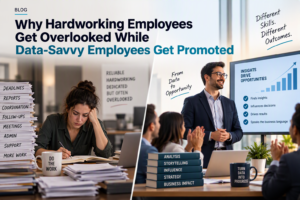

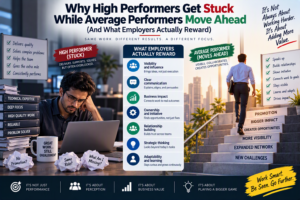


Hardworking employees get overlooked in almost every workplace, and it stings every single time. You stay late, you cover for colleagues, you never miss a deadline. Then review season arrives and the promotion goes to the person who seems to do less but somehow has the numbers, the dashboard and the confidence to back up their case. It feels unfair, and in many ways it is. But it is also predictable, and once you understand why, it is fixable.
This guide explains why hardworking employees get overlooked, what data-savvy colleagues are doing differently, and the practical Excel and data skills that turn effort into visible, measurable value. It is written for Australian professionals in Sydney, Melbourne, Brisbane, Perth, Adelaide, Canberra and everywhere in between who want their work to be recognised, without having to become a data scientist.
Hard Work Is Not the Same as Visible Value
Managers are busy. They rarely see how many hours you put in, and when they do, effort is hard to compare across people. What they can compare is evidence: a saved cost, a faster process, a clearer forecast, a number that moved. Effort is private. Impact is portable, and it is what travels up the chain when promotion decisions are made behind closed doors.
That is the core reason hardworking employees get overlooked. They are rewarded with more work, because reliable people are useful where they are. Data-savvy employees are rewarded with more responsibility, because their output can be explained in one sentence and defended with a chart.
None of this means data-savvy people work harder or are smarter. It means they translate their work into the language that decision makers trust.
7 Reasons Hardworking Employees Get Overlooked for Promotion

1. Your effort is invisible and your results are not measured
If you cannot show before-and-after numbers, your contribution is described in adjectives: reliable, dedicated, helpful. Promotions are justified with nouns and numbers. A finance officer in Melbourne who says “I reduced month-end close from six days to four” is far more memorable than one who says “I always work hard at month-end”.
2. Manual work buries your best hours
Copying data between workbooks, rebuilding the same report every Monday and fixing formulas by hand all feel like diligence. In reality they consume the time you could spend analysing and improving. Employees who automate with Power Query, PivotTables and dynamic arrays free up hours that go straight into higher-value work, and that is what gets noticed.
3. You report activity instead of outcomes
“I sent 200 emails and processed 80 invoices” describes a busy week. “I cut invoice errors by a third, saving about two hours of rework a week” describes a result. When hardworking employees get overlooked, it is often because their updates read like timesheets, not business cases.
4. Your promotion case has no numbers in it
Ask any hiring manager how they decide between two strong candidates and you will hear the same answer: whoever makes it easier to justify the choice. Data makes that easy. Without it, you are asking your manager to defend a gut feeling to their own boss, and most will quietly choose the person who arrives with evidence.
5. Decision makers trust data more than opinion
Senior leaders are held accountable for results, so they lean on measurable information. When two people propose different ideas, the one with a clean chart usually wins, even if the other has more experience. Being data-savvy is not about being clever. It is about speaking the dialect that leadership already uses.
6. You are too useful where you are
This one is painful. If you are the reliable pair of hands that keeps a process running, your manager has a reason to keep you exactly there. Moving you up creates a gap. Data-savvy employees avoid this by documenting, automating and teaching their processes so they can hand them off and move forward.
7. Your skills gap is visible, even if nobody mentions it
Colleagues who have mastered XLOOKUP, PivotTables, Power Query and basic Power BI produce cleaner work in less time. Managers notice, even when they never say so. A modest skills gap in Excel and data analysis can quietly cap how senior you are allowed to become, especially in roles that touch budgets, reporting or performance.
What Data-Savvy Employees Do Differently
Here is how the two profiles typically show up at work. Notice that nothing in the right-hand column requires a degree in statistics.
| Area | Hardworking but overlooked | Data-savvy and promoted |
| Reporting | Rebuilds reports by hand each week | Automates with Power Query and PivotTables |
| Updates | Describes tasks completed | Shows outcomes with numbers and charts |
| Problem solving | Relies on experience and effort | Backs ideas with evidence |
| Time use | Spends hours on repetitive work | Automates and spends time on analysis |
| Promotion case | Lists duties and loyalty | Presents measurable impact |
| Visibility | Waits to be noticed | Shares insights with decision makers |
The reason hardworking employees get overlooked is mostly a skills and habits gap, which means it is mostly learnable.
The Data Skill Stack That Gets You Noticed (No Data Science Degree Needed)
You do not need to learn everything to avoid being one of the hardworking employees who get overlooked. A focused set of practical skills delivers most of the visible benefit.
- Core Excel: XLOOKUP, IF and IFS logic, text functions, data validation and clean formatting. These remove errors and build trust in your numbers.
- PivotTables and charts: the fastest way to turn raw data into a clear story. Every manager understands a good chart.
- Power Query: cleans and combines data automatically so your Monday report refreshes itself. This is often the biggest time saver.
- Dynamic arrays and modern formulas: FILTER, SORT, UNIQUE and LET make complex analysis shorter and easier to audit.
- Power BI basics: interactive dashboards that leaders can explore without asking you for a new version each week.
- Microsoft Copilot in Excel: speeds up analysis and summaries, but only helps if you can check and explain the results.
Most professionals can move from basic to confident in a few months of structured learning, which is why the right Excel course online is one of the highest-return investments you can make in your career.
How to Stop Being Overlooked: A 90-Day Plan
Start where you are. You can apply this plan inside your current role without waiting for permission.
| Phase | Focus | What to do |
| Days 1 to 30 | Make your work measurable | Pick three recurring tasks and record time taken, error rates or volume. These become your before-and-after baselines. |
| Days 31 to 60 | Automate and improve | Use Power Query, PivotTables and formulas to automate one report or process. Record the time saved. |
| Days 61 to 90 | Share the story | Present one result to your manager as a short summary: problem, action, number. Ask what else they would like measured. |
If you want to avoid the pattern where hardworking employees get overlooked, start here. Ninety days from now you will have real evidence of impact, which is exactly what a promotion conversation needs.
Myths That Keep Hardworking Employees Overlooked
Some well-meaning beliefs quietly keep people stuck. Hardworking employees get overlooked more often when they hold onto these.
- “My work should speak for itself.” It rarely does. Work only speaks when someone translates it into results that a busy manager can repeat in a meeting.
- “Asking for credit is arrogant.” Sharing results is not bragging, it is giving your manager the information they need to advocate for you.
- “Data skills are for analysts.” Excel and basic analytics now sit inside HR, finance, operations, marketing and admin roles. They are workplace skills, not specialist ones.
- “I am too late to learn this.” Most professionals pick up the core skills in a few months, and you can start with the exact tasks you already do every week.
- “Being busy proves I am valuable.” Busy shows effort. Value shows in outcomes. Hardworking employees get overlooked when they confuse the two.
Once you drop these myths, the path forward is surprisingly simple: measure your work, improve one process at a time and share the result.
What Managers Actually Notice When Hardworking Employees Get Overlooked
Ask managers privately and you will hear a consistent pattern. They notice who brings clarity to meetings, who spots problems early and who can answer “how do you know?” without scrambling. They remember the employee who showed a simple chart that settled an argument. They rarely remember who stayed latest.
That is not cynicism. It is how limited attention works. When hardworking employees get overlooked, it is usually because the manager had no easy, concrete story to tell about them. Give them that story, and you change the outcome.
Examples of Data-Savvy Wins in Everyday Roles
You do not need an analyst title for this to work. Here are common examples from ordinary jobs.
- HR: tracking turnover and absence trends in a PivotTable, then flagging a team that needs support before problems grow.
- Finance and accounts: automating bank reconciliations and month-end reports so the team closes books days earlier.
- Operations: using Power Query to combine supplier data and spot delays before they affect customers.
- Marketing: comparing campaign results across channels in one dashboard to show where spend actually works.
- Administration and office management: building a simple tracker that replaces three recurring email chases and shows the saved hours.
Each example takes a normal task and adds a number. That small step is what separates a reliable employee from a promotable one.
Why Hardworking Employees Get Overlooked Differently Across Australian Cities
The pattern repeats nationally, but local job markets shape how it plays out.
- Sydney: finance, consulting and professional services reward measurable impact heavily. Data skills are close to a baseline expectation.
- Melbourne: retail, health and tech teams value process improvement. Showing time saved is a strong promotion argument.
- Brisbane and the Gold Coast: growing public sector and infrastructure teams increasingly expect dashboard-based reporting.
- Perth: resources and engineering organisations expect clear operational and cost reporting from every level.
- Adelaide: health, education and defence workplaces reward accuracy and clear data governance.
- Canberra: the public service rewards staff who can turn data into briefings and defensible recommendations.
Wherever you work, the principle holds. Hardworking employees get overlooked when their work cannot be measured, and data skills make it measurable. For a view of how workplace skills are shifting, Microsoft’s Work Trend Index is a useful external reference.
Courses That Help You Build Visible, Promotable Skills
Self-teaching works for some people, but structured courses save months of trial and error and give you a certificate to point to. These are the pathways Australian professionals ask about most.
- Excel courses online: from beginner to advanced, covering formulas, PivotTables, XLOOKUP and Power Query. Browse our full Excel course range.
- Power BI: build interactive dashboards once Excel feels comfortable. Explore the Power BI course.
- Data analytics: for those who want to move into analyst or leadership roles. See our data analytics courses.
- Wider IT and business training: explore the full catalogue at Logitrain.
Quick Self-Audit: Are You One of the Hardworking Employees Getting Overlooked?
Answer honestly. Each “no” is a place to focus.
- Can you name three measurable results you delivered this year?
- Have you automated at least one repetitive task?
- Do your updates to your manager include numbers, not just task lists?
- Can you build a PivotTable and chart from raw data in under ten minutes?
- Have you shared an insight with a senior stakeholder in the last quarter?
- Do you have a learning plan for Excel and data skills?
If you answered no to three or more, you are in the group where hardworking employees get overlooked, and the 90-day plan above is your starting point.
Frequently Asked Questions
Why do hardworking employees get overlooked for promotion?
Hardworking employees get overlooked because effort is hard to see and compare, while measurable results are easy to defend. Employees who show numbers make the promotion decision easier for their managers.
Do I need to be a data analyst to stop being overlooked?
No. Hardworking employees get overlooked in every kind of role, and data-savvy simply means you can organise, analyse and present information to support decisions. Solid Excel skills, PivotTables and Power Query already put you ahead of most colleagues.
Which Excel skills help most with promotions?
XLOOKUP, PivotTables, charts, Power Query and clean reporting habits deliver the most visible impact. They save time and make your work easier to trust.
How long does it take to build these skills?
With structured learning and regular practice, most professionals feel confident with core data skills in two to four months. You will see early wins much sooner, usually within the first few weeks.
Will learning data skills really help my career?
It improves your chances by making your impact visible and your work more efficient. It does not replace relationships or performance, but it removes a major reason hardworking employees get overlooked.
Make Your Hard Work Impossible to Ignore
You do not have to work harder to be noticed. You have to make your work visible, measurable and easy to explain. When hardworking employees get overlooked, it is rarely about effort. It is about evidence, and evidence is a skill you can build.
Ready to start? Explore our Excel courses online, add dashboards with the Power BI course, or take the next step with data analytics training. You can also browse the full range at Logitrain.