
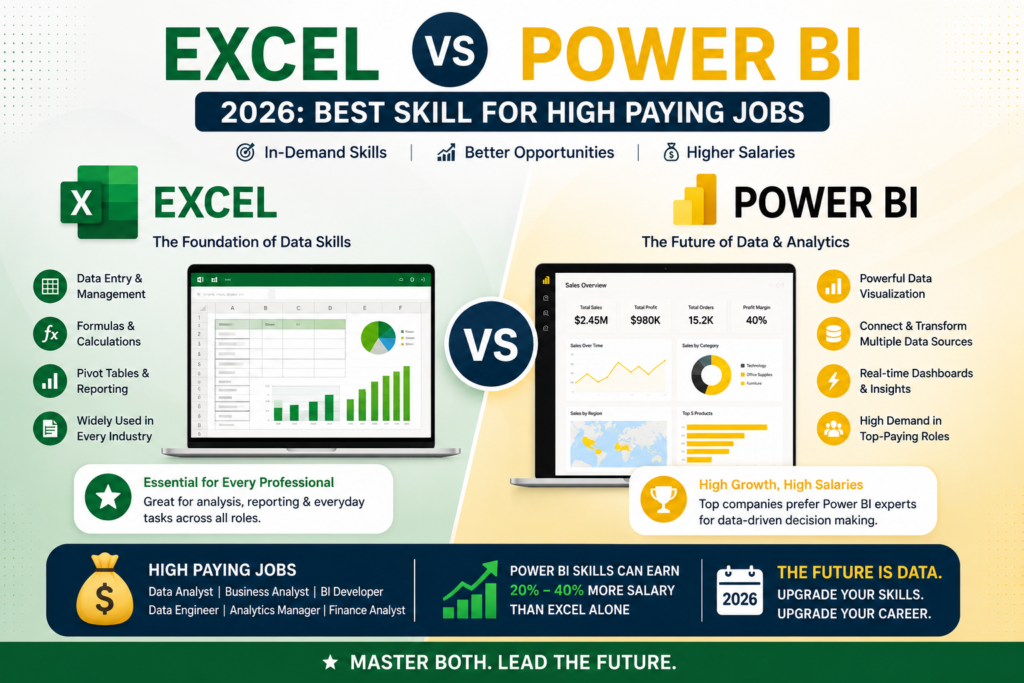
If you are wondering whether to master Excel vs Power BI Australia in 2026, you are not alone. Thousands of Australians are facing the same career decision right now and the choice you make can directly shape your salary, job opportunities, and career growth. Let us break it all down clearly so you can decide with confidence.
What is Microsoft Excel?
Microsoft Excel is the world’s most widely used spreadsheet application. It helps you organise data, build complex formulas, create charts, and run calculations all in a familiar grid-based environment.
For decades, Excel has been a non-negotiable core skill across virtually every Australian workplace. Whether you work in finance, healthcare, administration, retail, or education, Excel is almost certainly part of your daily workflow. It remains the go-to tool for quick data entry, reporting, and analysis at the task level.
What is Power BI?
Power BI is Microsoft dedicated business intelligence and data visualisation platform. Unlike Excel, Power BI is designed specifically for analysing large datasets, building interactive dashboards, and sharing data-driven insights across entire organisations.
In 2026, Power BI has firmly established itself as one of the most sought-after tools for data analyst and business intelligence roles particularly in larger Australian companies that need to process and present complex data at scale.
Key Differences Between Excel and Power BI Australia
Understanding how these two tools differ helps you make a smarter learning decision. Here is a side-by-side comparison:
| Feature | Excel | Power BI |
| Primary Use | Spreadsheets & formulas | Data visualisation & BI |
| Data Handling | Up to ~1 million rows | Millions of rows |
| Collaboration | Limited | Built-in sharing & publishing |
| Learning Curve | Beginner-friendly | Moderate |
| Best For | Entry to mid-level jobs | Mid to senior-level jobs |
| Avg. Australian Salary | $60K – $90K | $85K – $130K |
Both tools are built by Microsoft and integrate seamlessly which is exactly why many Australian employers now look for professionals who are confident in both.
Excel vs Power BI Which is Better for Jobs in Australia?
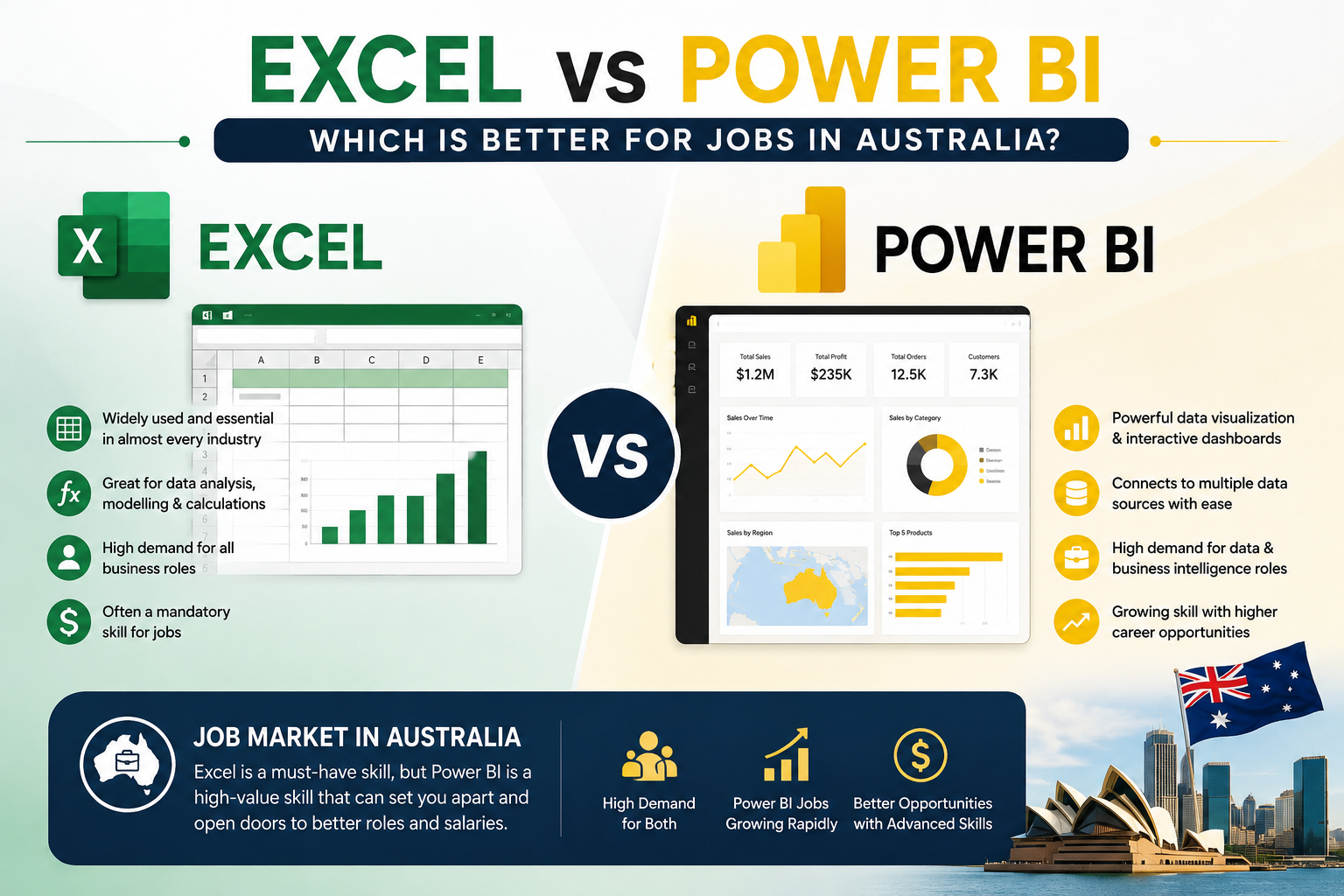
The straight answer is it depends on where you are in your career journey.
For entry-level roles in Australia, Excel is the essential starting point. Job advertisements for administrative assistants, finance officers, marketing coordinators, and operations staff consistently list Excel as a required or preferred skill. Without Excel proficiency, you will struggle to get past most job applications.
For mid-to-senior level positions especially data analyst, business analyst, or BI developer roles Power BI is increasingly expected alongside Excel. Employers in 2026 want professionals who can not only organise data in a spreadsheet but also tell a compelling visual story with it.
The smart strategy for Australians in 2026: master Excel first, then add Power BI to your skill set. This combination puts you in the strongest possible position across both entry-level and senior roles.
Salary Comparison in Australia (2026)
Money talks. Here is what the Excel vs Power BI salary gap looks like across Australia’s major cities:
| City | Excel Roles (AUD/yr) | Power BI Roles (AUD/yr) | Key Industries |
| Sydney | $65,000 – $90,000 | $95,000 – $130,000 | Finance, Tech, Banking |
| Melbourne | $60,000 – $85,000 | $90,000 – $125,000 | Business, Analytics, Consulting |
| Brisbane | $55,000 – $80,000 | $80,000 – $115,000 | Admin, SMEs, Government |
| Perth | $60,000 – $85,000 | $85,000 – $120,000 | Mining, Logistics, Operations |
Key takeaway: Adding Power BI to your Excel skills can realistically boost your annual salary by $20,000 to $40,000 or more, depending on your industry and experience level.
When Should You Learn Excel?
Excel is the right starting point if:
- You are new to data tools or office software
- You are applying for admin, finance, or operations roles
- You want a job-ready skill you can use almost immediately
- You work in or are targeting a small to medium-sized business (SME)
Think of Excel as the foundation of your data literacy. Without it, Power BI concepts will be far more difficult to grasp and apply in real-world scenarios.
When Should You Learn Power BI?
Move on to Power BI when:
- You are comfortable with Excel fundamentals and want to level up
- You want to transition into data analytics or business intelligence
- Your company or target employer works with large or complex datasets
- You are aiming for a salary above $90,000 per year in Australia
Best Learning Path (Excel → Power BI)
The most recommended and effective career path for Australians in 2026:
- Step 1 – Excel Fundamentals: Learn formulas, basic charts, and PivotTables
- Step 2 – Excel Advanced: Master Power Query, VLOOKUP/XLOOKUP, and data modelling
- Step 3 – Power BI Basics: Learn DAX, data connectors, and report creation
- Step 4 – Power BI Advanced: Build complex dashboards and publish to Power BI Service
Following this path makes you genuinely competitive for both analyst and senior BI roles across Australia. Many professionals complete this journey in 6 to 12 months with consistent practice.
Final Verdict
When it comes to Excel vs Power BI, this is not really an either/or decision it is a both. Start with Excel to get hired. Add Power BI to get promoted and earn significantly more. Together, these two Microsoft tools give you one of the most powerful and versatile skill combinations available in the Australian job market in 2026.
FAQs – Excel vs Power BI in Australia
Should I learn Excel or Power BI first in Australia?
Start with Excel because most entry-level jobs in Australia require Excel skills. Once you have mastered the basics, move on to Power BI for higher-paying data and analytics roles.
Is Excel still in demand in Australia in 2026?
Yes, absolutely. Excel remains widely used across industries including finance, administration, healthcare, retail, and business reporting throughout Australia. Demand shows no sign of slowing down.
Which pays more in Australia: Excel or Power BI?
Power BI roles consistently pay more because they involve advanced data analysis, complex dashboards, and strategic business reporting. However, Excel skills are essential to qualify for most Power BI positions in the first place.
Is Power BI better than Excel for getting a job in Sydney?
In Sydney, both skills are valuable across the city’s thriving finance and technology sectors. That said, Power BI offers stronger opportunities in data analyst and business intelligence roles, where Sydney employers pay premium salaries.
What Excel skills are most in demand in Melbourne?
Melbourne employers typically look for:
- PivotTables and PivotCharts for data summarisation
- Advanced data analysis using formulas and functions
- Dashboard creation and visual reporting
- Advanced formulas including XLOOKUP, INDEX/MATCH, and array formulas
Can beginners learn Excel easily in Brisbane?
Yes. Excel is one of the most beginner-friendly tools available. With structured training and regular practice, most learners in Brisbane can build job-ready basic Excel skills within just a few weeks.
Are Excel jobs available in Perth?
Yes, and in significant numbers. Perth’s mining, logistics, resources, and administration sectors all rely heavily on Excel skills. If you are in Perth and job-hunting, Excel proficiency is practically a must-have.
Do Australian companies prefer Excel or Power BI?
Most Australian companies use both tools, but for different purposes:
- Excel for day-to-day data entry, calculations, and smaller reporting tasks
- Power BI for company-wide reporting, interactive dashboards, and executive presentations
Is Excel enough for a job in Australia?
For entry-level roles, yes Excel alone can get you hired. However, for high-paying roles above $90,000 per year, combining Excel with Power BI is strongly recommended. The combination significantly increases your employability and earning potential.
Where can I learn Excel or Power BI in Australia?
You can develop both skills through reputable online courses, Microsoft-certified training programmes, community college classes, and hands-on practice platforms. Look for courses that include real-world projects and recognised certificates.
Excel vs Power BI in Major Australian Cities
Sydney – Finance, banking, and technology companies drive the highest demand for both Excel and Power BI skills. Sydney consistently offers the highest salaries in the country for data-related roles.
- Finance & banking: heavy Excel use for modelling and reporting
- Tech companies: Power BI for data pipelines and business reporting
- Consulting firms: both tools used daily across all levels
Melbourne – Business services, analytics firms, and a thriving startup ecosystem make Melbourne one of Australia’s strongest markets for Power BI professionals.
- Business analytics: strong Power BI demand in mid to large enterprises
- Professional services: Excel remains core for client-facing deliverables
- Government sector: growing adoption of Power BI for public reporting
Brisbane – A growing market where SMEs and government agencies are increasingly adopting data tools. Brisbane represents an excellent entry point for professionals building their Excel and Power BI career.
- SMEs: Excel is still the dominant tool for most small businesses
- Government departments: adopting Power BI rapidly for reporting dashboards
- Administration roles: strong ongoing demand for Excel proficiency
Perth – Mining, resources, and logistics dominate Perth’s economy and all three sectors rely heavily on Excel for day-to-day operations. Power BI is growing quickly in larger resource companies.
- Mining & resources: Excel critical for operational tracking and reporting
- Logistics & supply chain: Excel for inventory and workflow management
- Large corporations: increasing Power BI adoption for executive dashboards
Ready to Start Your Excel and Power BI Journey?
Whether you are just starting out or looking to upskill for a higher salary, the path forward is clear. Learn Excel vs Power BI in the right order, build practical skills through hands-on projects, and target roles in your Australian city where demand is strongest.
The Australian job market in 2026 rewards those who invest in the right skills. Excel and Power BI together are two of the most valuable tools you can master and the return on your learning investment is measurable in your very next pay cheque